Disclaimer: The measurements used in this study are based primarily on listed sizes from NBA.com and other widely available draft/combine data. In some cases, exact wingspans were unavailable because not every NBA player participated in or was officially measured at the NBA Draft Combine.
When necessary, we used the most credible and likely wingspan estimates available through extensive research.
Additionally, listed player weights can fluctuate over time and may not perfectly reflect a player’s present playing weight.
The goal of this study is not to claim laboratory-level precision, but rather to establish reasonable and well-researched positional size benchmarks for comparison purposes.
While there is certainly some variance from reality, the broader trends and conclusions remain highly instructive.
Positional size, you say? May 11, 2026. — By Bobby Gerould
Playoff teams provide a much cleaner picture of what actually works in the modern NBA. Rather than studying the entire league, including lottery teams and rebuilding rosters, we focused only on teams good enough to reach the postseason. The goal was simple: identify the average positional size profiles of winning NBA teams, with an emphasis on wingspan and weight more than listed height. In many cases, length and strength are more relevant than traditional height measurements when projecting functional NBA size.
To build the chart below, we used the ten players on each playoff team that averaged the most minutes during the regular season. Those groups were then divided into “main-five” and “second-five” units based on minute distribution. This is not intended to rigidly define true positions, because basketball doesn’t always work that neatly. Sometimes the player assigned as the “four” within a second-five grouping may actually be a wing or combo guard simply functioning as the largest perimeter player in that lineup context. The objective here is not perfect positional labeling, but rather to establish a practical snapshot of the size realities commonly found on playoff-caliber NBA teams.
What did we find?
To help provide visual reference points for these averages, below are examples of NBA players whose physical dimensions closely align with the positional norms found among playoff-caliber starters. Again, this is strictly about size profiles, not stylistic comparisons or player quality.
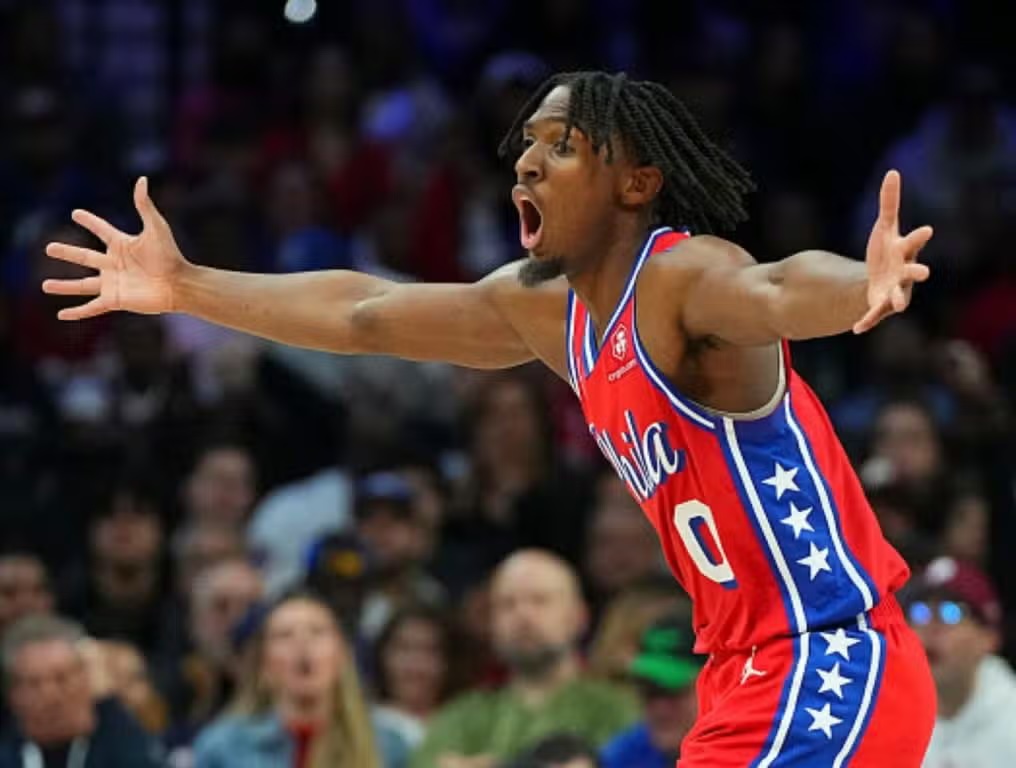
At point guard, the average starter measured roughly a 6'7" wingspan and 201 pounds. Jrue Holiday (6'7" wingspan, 205 lbs.) and Tyrese Maxey (photo below) (6'6" wingspan, 200 lbs.) both fit closely within that range.
The average starting shooting guard came in around a 6'9" wingspan and 206 pounds. Stephon Castle (6'9" wingspan, 210 lbs.) and Nickeil Alexander-Walker (6'10" wingspan, 205 lbs.) are representative examples of that archetype.
At small forward, playoff-team starters averaged approximately a 6'11" wingspan and 210 pounds. Cam Johnson (6'10" wingspan, 210 lbs.) lands almost directly on the averages, while Franz Wagner (7'0" wingspan, 220 lbs.) represents a slightly larger variation of the same general mold.
Power forwards averaged roughly a 7'1" wingspan and 225 pounds. Jabari Smith Jr., with a 7'1" wingspan and a listed weight of 220 pounds, closely mirrors the positional averages identified in this study.
Among centers, the average starter on playoff teams measured approximately a 7'4" wingspan and 247 pounds. Karl-Anthony Towns (7'4" wingspan, 248 lbs.) and Neemias Queta (7'4" wingspan, 248 lbs.) are almost exact matches. It should also be noted that Victor Wembanyama slightly skewed the center wingspan averages upward due to his extraordinary 8'0" wingspan.
Of course, averages are not hard rules. Several playoff-caliber teams featured players who fell well below the positional size norms identified in this study. In most cases, those players compensate with high-level skill, toughness, processing speed, shot-making, or defensive instincts that allow them to survive despite lacking prototypical dimensions.
At point guard, some of the smaller outliers included Reed Sheppard (6'3" wingspan, 185 lbs.), Jalen Brunson, and Collin Gillespie, the latter two both carrying 6'4" wingspans. Among shooting guards, Desmond Bane stands out as notably short-armed relative to the average, measuring a 6'4" wingspan despite functioning effectively as a powerful scoring guard.
At small forward, both Jaylon Tyson and Devin Booker came in with 6'8" wingspans, significantly below the average playoff-team small forward profile identified in this study. At power forward, Dillon Brooks was an extreme outlier with just a 6'6" wingspan while still regularly defending larger forwards through strength and competitiveness.
The center position produced perhaps the most revealing example of how roster construction can skew smaller than ideal. Because Mark Williams and Oso Ighodaro did not rank among the top five Phoenix Suns players in minutes per game, the Suns’ “center” representative within this exercise became Royce O'Neale, who owns just a 6'10" wingspan. In many ways, the exercise highlighted how undersized the Suns become across multiple positions when Williams is unavailable or unable to handle major minutes.
The table below shows the first five on top, and the teams' second five on the bottom.
Team
1
WS
weight
2
WS
Wt.
3
WS
wt.
4
WS
Wt.
5
WS
wt.
San Antonio
Fox
6’6”
185
Castle
6’9”
210
Vassell
6’10”
200
Champagnie, Julian
6’10”
217
Wembanyama
8’0”
235
Philly
Maxey
6’6”
200
Edgecombe
6’8”
193
Oubre
7’2”
203
George, Paul
6’11”
230
Embiid
7’5”
270
Atlanta
CJ McCollum
6’6”
197
Alexander-Walker
6’10”
205
Daniels, Dyson
6’11”
199
Johnson, Jalen
7’0”
219
Okongwu
7’3”
240
New York
Brunson
6’4”
190
Hart
6’8”
215
Bridges, Mikal
7’1”
209
Anunoby
7’2”
240
Towns
7’4"
248
Denver
Murray
6’6”
215
Braun
6’7”
220
Johnson, Cam
6’10”
210
Watson, P
7’1”
200
Jokic
7’3"
284
Toronto
Quickley
6’8”
190
Ingram, B.
7’3”
190
Barrett, RJ
6’10”
214
Barnes, S.
7’3”
237
Poeltl
7’3”
253
Detroit
Cunningham
7’0"
220
Thompson, Ausar
7’0”
205
Robinson, Duncan
7’1”
215
Harris, Tobias
6’11”
226
Duren
7’5"
250
Orlando
Black, Anthony
6’8”
200
Bane
6’4”
215
F Wagner
7’0"
220
Banchero
7’6”
250
W. Carter Jr.
7’5"
270
Lakers
Smart
6’9”
220
Reaves, A.
6’6”
197
Doncic
7’0” *
230
Hachimura
7’2”
230
James, LeBron
7’0”
250
Portland
Holiday, Jrue
6’7”
205
Sharpe, S.
7’0”
210
Avdija
6’9”
228
Grant, J.
7’3”
213
Camara
7’1”
230
Houston
Sheppard
6’3”
185
Thompson, Amen
7’0”
200
Durant
7’5”
240
Smith, Jabari
7’1”
220
Sengun
7’1”
243
Minnesota
DiVincenzo
6’6”
203
A Edwards
6’9”
225
Jaden McDaniels
7’0"
185
Randle
7’0”
250
Gobert
7’9"
258
Phoenix
Gillespie
6’4”
195
Allen, G.
6’7”
198
Booker
6’8”
206
Brooks, D.
6’6”
225
O’Neale
6’10”
226
Cleveland
Donovan Mitchell
6’10”
215
Harden
6’11”
220
Tyson, J.
6’8”
215
Mobley
7’4"
215
Allen
7’6"
243
Boston
Pritchard
6’5”
195
D White
6’8”
190
J Brown
7’0"
223
Tatum
6’11"
210
Queta
7’4”
248
OKC
SGA
6’11”
195
Cason Wallace
6’9"
195
Dort
6’9"
220
Jalen Williams
7’2"
211
Holmgren
7’6”
208
Starters
AVERAGE
6’7
200.6
6’9”
205.5
6’11”
210.1
7’1”
224.5
7’4”
247.2
OKC
Mitchell, Ajay
6’6”
190
Isaiah Joe
6’8”
165
Aaron Wiggins
6’10"
190
Jaylin Williams
7’2”
240
Hartenstein
7’2”
250
Denver
Pickett
6’7"
202
Brown, Bruce
6’9”
202
Hardaway
6’7”
205
Jones, Spencer
6’11”
225
A Gordon
7’0”
235
Minnesota
Conley
6’6”
175
Hyland, Bones
6’9”
169
Dosunmu
6’10”
200
Anderson, Kyle
7’3”
230
Reid
7’3”
264
Toronto
Shead
6’3”
201
Walter, Jakobe
6’10”
198
Agbaji
6’10”
215
Murray-Boyles
7’1”
239
Mamukelashvili
7’1”
240
Atlanta
Kispert
6’7”
224
Risacher
6’10”
195
Kuminga
6’11”
225
Gueye
7’4”
212
Landale
7’3"
255
Philly
Payne
6’7”
183
Grimes
6’8”
210
Barlow
7’3”
218
Bona
7’4”
243
Drummond
7’6”
279
Lakers
Kennard
6’5”
206
LaRavia
6’10”
235
Vanderbilt
7’1”
214
Hayes, Jaxson
7’4"
220
Ayton
7’5”
252
Houston
Holiday, A.
6’8”
185
Okogie
7’0”
212
Eason
7’2”
215
Finney-Smith
7’0"
220
Adams, S.
7’5”
265
Boston
Scheierman
6’8”
209
Walsh
7’3”
205
Hauser
6’9”
217
Garza
7’2”
243
Vucevic
7’5”
260
New York
Alvarado
6’1”
179
McBride
6’9”
195
Shamet
6’7"
190
Clarkson
6’8”
194
Robinson, M.
7’4”
240
Portland
Henderson, Scoot
6’9”
206
Love, C.
6’9”
204
Krejci
7’0"
195
Murray, Kris
7’0”
215
Clingan
7’7”
282
Cleveland
Merrill
6’5"
205
Schroeder
6’8”
175
Ellis, K.
6’9”
175
Strus
6’8”
215
Wade
6’10"
228
Orlando
Carter, Javon
6’4”
198
Suggs
6’6”
205
Penda
7’0”
242
DaSilva
6’10”
217
Bitadze
7’2”
250
Phoenix
Goodwin, Jordan
6’10”
208
Green, Jalen
6’8”
186
Dunn, Ryan
7’2”
214
Ighodaro
6’11”
222
Williams, Mark
7’7”
242
San Antonio
Harper, Dylan
6’11”
213
Johnson, Keldon
6’9”
220
Barnes, Harrison
6’11”
225
Bryant, Carter
7’0”
215
Kornet
7’6”
250
Detroit
Jenkins, D.
6’8”
165
Holland, R.
6’11”
197
LeVert
6’10”
205
Huerter
6’8”
198
Stewart, I.
7’5”
250
2nd five
AVERAGE
6’7”
197
6’9”
198
6’11"
209
7’0”
222
7’4”
253
If you are curious how the 2025-26 Sacramento Kings compared, the results of this exercise were revealing. Among the Kings’ primary starters, the only position where Sacramento exceeded the playoff-team average size profile was at point guard, where Russell Westbrook has a 6'8" wingspan at 200 pounds. Everywhere else, the Kings generally fell at or below the positional norms identified among playoff teams.
At shooting guard, Zach LaVine came in slightly below average with a 6'8" wingspan and 200-pound frame. DeMar DeRozan, functioning as a small forward in this study, measured a 6'9" wingspan at 220 pounds, also below the average playoff-team SF length profile. Keegan Murray is close in the the power forward averages at a 6'11" wingspan and 225 pounds. The biggest size gap appeared at center, where Domantas Sabonis measured a 6'11" wingspan at 240 pounds, significantly below the average playoff-team starting center dimensions of a 7'4" wingspan and 247 pounds.